Frozen Shoulder Treatment in Kolkata
Assessment-led physiotherapy for frozen shoulder (adhesive capsulitis)
Overview
Frozen shoulder (adhesive capsulitis) makes the shoulder painful and increasingly stiff, so everyday tasks like dressing, combing your hair or reaching a shelf become hard. It usually gets better on its own over months to a couple of years, and the right care can ease pain and help you keep and regain movement in the meantime. Every first visit starts with an assessment by Dr. Partha Sarathi Neogi, so you know whether it really is frozen shoulder or another shoulder problem, and what care suits you.
Reviewed by Dr. Partha Sarathi Neogi, BPT, MPT (Neurology) · 29 October 2026
How Dr. Neogi assesses shoulder pain and stiffness
- Your history: when the pain and stiffness started, any injury, what you cannot do, how you sleep, and conditions such as diabetes or thyroid problems.
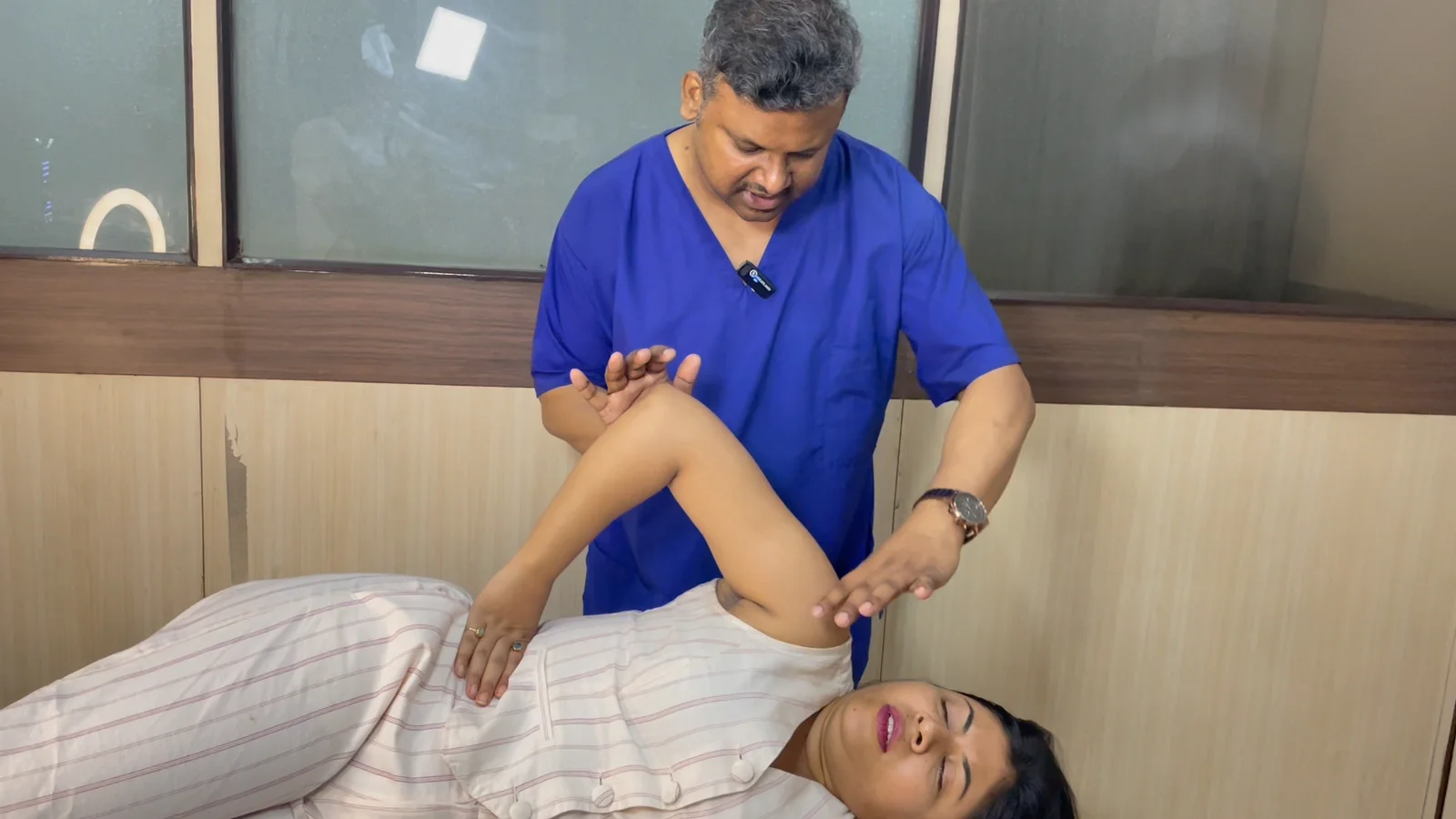
- How far your shoulder moves on its own and when he moves it for you. In frozen shoulder both are stiff, which helps tell it apart from a rotator cuff problem.
- A check of your neck, because neck problems can also cause shoulder and arm pain.
- A plain-language explanation of what he found, which stage you seem to be in, and whether you need a doctor's opinion, a scan or an injection first.
The stages of frozen shoulder, and how many sessions you may need
In frozen shoulder the capsule around the shoulder joint becomes inflamed, thickened and tight. It usually passes through three overlapping stages: a painful "freezing" stage when stiffness builds, a "frozen" stage when pain may ease but the shoulder stays very stiff, and a "thawing" stage when movement slowly returns. The whole course often takes from several months to two or three years. It is more common between 40 and 60 years of age and in people with diabetes.
Care depends on the stage: in the painful stage the aim is to ease pain and keep gentle movement; later the focus moves to stretching and strengthening. How many sessions you need depends on your stage, how long you have had it and how you respond, and session length depends on your condition and the treatment planned. Progress is reviewed at each visit. Your doctor may also suggest pain medicine or a steroid injection, especially in the painful stage, and physiotherapy can be combined with these.
Who we often see with frozen shoulder
- Shoulder pain and stiffness that came on slowly without a clear injury
- People with diabetes or thyroid problems who develop shoulder stiffness
- Stiffness after keeping the arm still for a while, for example after an injury or surgery
- Difficulty dressing, reaching behind your back or sleeping on that side
- Frozen shoulder diagnosed by a doctor, with or without an injection
- Shoulder pain that may come from the neck or rotator cuff and needs to be told apart
Treatment options (planned after your assessment)
- Gentle joint mobilisation and other hands-on techniques, matched to how painful the shoulder is
- A home exercise programme: gentle movement in the painful stage, then stretching and strengthening
- Therapeutic ultrasound or TENS/IFT for short-term pain relief in some cases, alongside exercise
- Dry needling for tight, painful muscles around the shoulder and neck, when suitable
- Advice on sleeping position, daily tasks and how much to push at each stage
- Clear advice on when to see a doctor about pain medicine or an injection
What you can do at home
- Keep the shoulder moving gently within comfort; avoid keeping it completely still.
- A warm pack before your exercises, for short periods, may make movement easier.
- Do your home exercises little and often, as shown; a stretch should feel like a stretch, not sharp pain.
- If lying on that side hurts, sleep with a pillow supporting the arm.
- For pain medicine, follow your doctor's or pharmacist's advice.
Plan your clinic visit
Consultation is ₹1,000 and treatment is ₹1,000, making ₹2,000 when both are provided. Confirm the charges for your planned visit before booking. Care is provided in clinic; home visits are not available.
Related conditions
Conditions with similar or overlapping symptoms.
Helpful guides
Exercise and recovery advice you can read before your visit.
Care at our Kolkata clinics
At our Kalighat clinic, frozen shoulder care starts with an assessment by Dr. Partha Sarathi Neogi, senior physiotherapist & chiropractic expert with 20+ years of clinical experience. He explains what he finds, whether hands-on care is likely to suit you, and when a doctor's opinion or a scan is needed first. Our Kalighat clinic is near Kalighat Metro and 27 Pally Park, Sahanagar. About the Kalighat clinic · Maniktala clinic and access
Frequently Asked Questions
It often lasts from several months to two or three years, passing through painful, stiff and recovery stages. Treatment aims to ease pain and keep and regain movement during this time, and progress is reviewed at each visit.
Yes. Most people recover without surgery, with exercise, physiotherapy and, when a doctor advises it, medicines or an injection. A procedure is considered only for a few people whose stiffness does not improve.
Yes. People with diabetes are more likely to get frozen shoulder, and it can take longer to settle. If you have diabetes and your shoulder is getting stiff, get it assessed early.
Yes, but the right amount depends on the stage. In the painful stage, gentle movement is better than forcing a stretch; later, stretching and strengthening become more important. Your exercises are adjusted as you improve.
In frozen shoulder the shoulder is stiff whether you move it or someone else moves it for you. With a rotator cuff problem, someone else can usually move it further than you can. Neck problems can also cause shoulder pain, which is why the first visit starts with an assessment.
It depends on your condition and stage. After the assessment you will be told what to expect, and your progress is reviewed at each visit.
Frozen Shoulder Treatment in Kolkata — Chiropractic Solution Kalighat
Looking for frozen shoulder treatment? At Chiropractic Solution in Kalighat, South Kolkata, every first visit starts with an assessment so you know what is likely causing your symptoms and whether our care suits you.
When to see a doctor or go to emergency first
Please seek urgent medical care instead of booking with us if you have:
- Shoulder or arm pain with chest pain, breathlessness, sweating or nausea (go to emergency)
- Shoulder pain after a fall or injury, especially if you cannot lift the arm or the shoulder looks out of shape
- A hot, red, swollen shoulder, or fever
- Sudden weakness or numbness in the arm or hand
- Shoulder pain with unexplained weight loss or a history of cancer
- Severe, constant pain that is not eased by rest or changing position
Do not stop any medicine your doctor has prescribed without speaking to them.
Our clinic serves patients from Kalighat, Hazra, Rashbehari, Gariahat, Ballygunge, Bhowanipore. Call or WhatsApp to book an assessment for frozen shoulder treatment at our Kalighat clinic (Mon–Sat, 9 am – 8 pm).
Ready to Start Your Recovery?
Book your appointment for Frozen Shoulder Treatment today at Chiropractic Solution, Kalighat, Kolkata.
Get In Touch With Us
Phone Number
+91 85830 66950Email Address
Parthas.neogi@gmail.comWorking Hours
Mon–Sat 9am – 8pm (Sunday closed)
Enquiry Here Below!
Other Physiotherapy Treatments
- Ankle Sprain Rehabilitation
- Wrist Pain & Carpal Tunnel Care
- Older Adult Balance Rehabilitation
- Manual Therapy & Physiotherapy
- Electrotherapy Treatment (IFT, TENS, Ultrasound)
- Exercise Therapy & Rehabilitation
- Post-Surgery Rehabilitation
- Neuro Physiotherapy & Stroke Rehabilitation
- Knee Pain & ACL Rehabilitation
- Dry Needling Therapy
- Heel Pain & Plantar Fasciitis Treatment
- Tennis Elbow & Golfer's Elbow Treatment
- Shoulder Pain & Rotator Cuff Treatment
- TMJ & Jaw Pain Treatment
- Vertigo Treatment (BPPV & Vestibular Rehab)
- Hip Pain Treatment
- Cervical Spondylosis Treatment
- Lumbar Spondylosis Treatment